Hello, Everyone. It’s been a few months, and I’ve been on sabbatical and travelling. While I miss Middle Earth and my local ocean beach haunt (not to mention my beloved and intrepid e-bike), this period has been invaluable for regrouping, re-evaluating, and reflecting on what has come before.

The week I left, I had the pleasure of helping to organize a conference (and chair a session) run by GOVIS, a New Zealand organization where I’ve had the honor of serving as a committee member. GOVIS evolved from the Government Information Systems Managers’ Forum and is a community that brings together people working in technology and information roles within New Zealand’s government. Since 1991, our organization has grown into a place where professionals can connect, learn from each other, and share ideas.
Through our annual conference and smaller events, GOVIS helps public servants and tech experts collaborate on solutions to make government services more efficient and accessible. What I really love about this organization (apart from it being populated by genuinely dedicated public servants and amazing human beings) is that we are creating space where public servants can engage meaningfully with our peers about how technology can be leveraged to serve New Zealand’s citizens better. And, importantly, GOVIS is committed to the core principles of equity, transparency, and inclusivity.
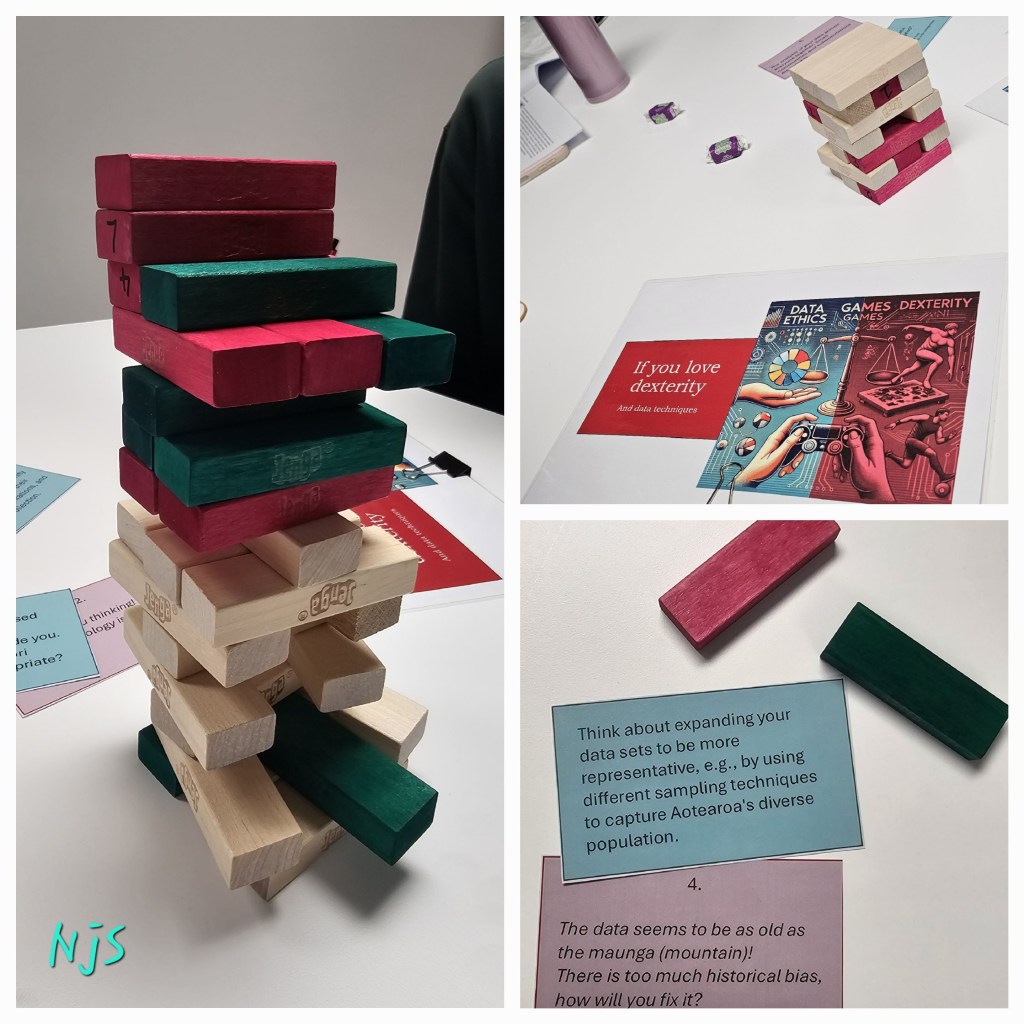
The GOVIS conference last month, titled “Trust to Innovate”, brought together public servants, tech experts, and thought leaders to explore how innovation can shape the future of government services while maintaining trust. On the workshop day, we explored themes like data governance and equity in data-driven technology, sparked meaningful discussions and, yes, even had some fun & games, courtesy of the team at the Centre for Data Ethics and Innovation.
At the conference itself, our keynote speakers covered a number of impactful topics, from using data effectively to governance in AI and digital public infrastructure. We were presented with case studies that highlighted successes in digital transformation, accessibility, and project management, making this year’s GOVIS conference a collaborative space focused on building trust through innovation. Our GOVIS conference this year provided a space for collaboration, with a focus on building trust through innovation. If you would like, you may visit our conference videos at the GOVIS YouTube Channel.
The purpose of my post today is to highlight work presented by one of our speakers. Accessibility has always been close to my heart. In Post #4, I mentioned my mum’s work with children living with special needs. Growing up, I saw firsthand how critical it was for every person to have equal access to the services and support they need. One of the standout moments for me at this year’s GOVIS conference was the introduction of the Centralised Web Accessibility Checker (CWAC) – pronounced *quack*.

Callum McMenamin is a Web Standards Consultant for the Digital Public Service branch of for the Government Chief Digital Officer (GCDO) at Te Tari Taiwhenua, the Department of Internal Affairs (DIA), New Zealand. Callum introduced the Centralised Web Accessibility Checker (CWAC), which is a powerful tool designed to help government agencies ensure their websites are accessible to all users, especially those with special needs. In Aotearoa New Zealand, government agencies are required to comply with the Web Accessibility Standard, which aligns with the Web Content Accessibility Guidelines (WCAG) 2.1 Level AA and ensures that public websites are accessible to all users, including those living with disabilities.
CWAC works by automating the process of scanning hundreds of government websites for accessibility issues, such as keyboard navigation and colour contrast problems. CWAC uses predefined rules to check compliance with accessibility standards, though some manual testing is still required to catch more complex issues. It offers broad insights into common accessibility barriers and provides agencies with actionable data to improve user experience. Although they may not catch every issue, tools like CWAC can play a critical role in helping public services meet the Web Accessibility Standards and ensure that no one is left behind in the digital space.
What are some common accessibility issues that tools like CWAC could typically spot?
- Keyboard Navigation – They can check that people can use a website just with a keyboard, without needing a mouse, which is important for those with physical disabilities or who use screen readers.
- Colour Contrast – They can ensure the text is easy to read by checking that the colours of the text and background don’t blend together, which helps users with visual impairments.
- Missing Alt Text for Images – They could look for images that don’t have descriptive text (alt text), which screen readers use to explain images to users living with visual impairments.
- Form Labels – They can check that forms on the website are clearly labelled so that users with accessibility needs can fill them out properly using assistive tools.
- Focus Indicators – They can ensure that when using a keyboard, buttons, links, and other interactive elements are highlighted to show where the user is on the page, which is key for people who don’t use a mouse.
- Headings Structure – They can check that the content is organized well with headings, making it easier for screen readers and users to navigate through a page.
- ARIA Issues – They can look for mistakes in coding that help people using assistive technologies (like screen readers) interact with more complex parts of a website.

ARIA stands for Accessible Rich Internet Applications and is a set of attributes used in HTML to make web content and applications more accessible, especially for people using assistive technologies like screen readers. ARIA helps create better interaction with dynamic web content, like buttons, dropdown menus, or sliders, which might not always be accessible otherwise. For example, ARIA attributes can describe elements that are interactive or update dynamically, ensuring that screen readers and other tools can provide the right information to users with accessibility needs.

Why are tools like CWAC a good thing?
While many countries rely on decentralized tools for monitoring (where individual agencies manage compliance on their own), New Zealand’s CWAC stands out. A centralized, automated system allows for consistent monitoring across government agencies and provides a comprehensive way to ensure accessibility. It allows for more streamlined compliance and reporting across all departments and makes it easier to track progress and to ensure that accessibility standards are met consistently across the board.
Both New Zealand and the European Union base their web accessibility guidelines on the global Web Content Accessibility Guidelines (WCAG) 2.1. In New Zealand, the Web Accessibility Standard applies specifically to government services and ensures that public sector websites meet accessibility requirements. In contrast, the European Union’s Web Accessibility Directive mandates that all public sector websites and mobile apps across EU member states comply with WCAG 2.1, making it a broader, region-wide requirement.
Countries like Finland and Germany have made impressive strides in web accessibility: Finland has developed tools like Salvia (open-source), and Germany enforces compliance through BITV 2.0. However, while countries in the European Union do indeed have accessibility requirements under the Web Accessibility Directive, monitoring is often decentralized. This means that individual agencies or departments handle compliance on their own without a unified system.
In the United States, Section 508 of the Rehabilitation Act mandates accessibility for federal agencies. The UK ensures compliance with WCAG 2.1 through its Government Digital Service. Canada has also implemented strong accessibility policies under the Accessible Canada Act.

Beyond the Western context, countries like India and South Africa have also been working towards digital accessibility. India’s Rights of Persons with Disabilities Act (RPWD) mandates that all digital platforms be made accessible while South Africa’s Web Content Accessibility Guidelines strives to ensure accessibility for its public sector websites. Brazil has attempted to address this space with its 2015 Brazilian Law of Inclusion, which mandates that public websites ensure accessibility for people living with disabilities. This law aligns with global standards like WCAG to create more inclusive digital spaces.
Tools like New Zealand’s CWAC could aid in making government websites accessible to everyone, especially those with disabilities, by automatically scanning for issues like colour contrast, keyboard navigation, and missing alt text. They are a perfect example of how innovation can be used to create a more inclusive digital landscape.
CWAC is open source and is available under the GPL-3.0 license, meaning anyone can access and use the code to improve accessibility on their websites. (It follows the NZGOAL-SE framework, which encourages New Zealand government software to be released as open source). Open-source tools like CWAC encourage broader collaboration and transparency. If you would like to learn more about CWAC specifically, please watch Callum McMenamin’s presentation from the GOVIS 2024 “Trust to Innovate” conference as below. He gave a fantastic talk.
As these digital services grow, AI has the potential to make accessibility tools like CWAC even smarter and more effective. While CWAC currently scans for common issues, AI could go further by recognizing patterns and predicting less obvious problems. It could even help websites adjust in real time and make them more adaptive and user-friendly for people with special needs. By integrating AI, tools like CWAC could evolve alongside technology and user needs and ensure that websites remain accessible.
Obviously, as we think about integrating AI into tools like CWAC, we must consider the equity implications. AI has the potential to enhance accessibility, but if not carefully governed, AI integration could unintentionally reinforce biases and leave some groups behind. Therefore, it is essential when integrating AI tools into initiatives like CWAC that the processes are transparent and inclusive. This will ensure that all users, regardless of their abilities or backgrounds, benefit from the improvements AI can bring such digital services. Emerging technology should serve everyone equally and equitably. Accessibility isn’t just a technical requirement—it is a matter of equity because government websites need to be accessible to all citizens, regardless of their abilities.

Equity isn’t some unreachable, lofty, ephemorous goal. Equity starts with concrete actions at the local or national level. Initiatives like CWAC and the others in my post illustrate that it is possible to prioritize accessibility and inclusivity within and across government digital services. Such initiatives can set a strong foundation for equity by ensuring that all citizens, including those with special needs, have access to essential services and information. If governments chose to integrate AI into digital accessibility tools like CWAC, they should ensure that their services remain adaptable and inclusive as technology evolves. When governments prioritize accessibility, they can create a ripple effect that can lead to broader societal equity.
My personal, academic, and professional journeys continually show me that while the context may shift, we can make a conscious choice to make the world more inclusive and equitable for everyone. These values have always given me my anchor, and I hope that these discussions help some of you find your own anchor as we navigate this rapidly evolving technoscape.
Equity begins at home🗺️wherever that is for you.📌

*✈️As an aside, I will be traveling again, so my next post will be in mid to late October.🌍Thank you for reading🦉
#Fairness #AI #Equity #TheGlobalFAIRSpace #AIandEquity #EmergingTechnology #ArtificialIntelligence #AIEthics #AITrends #EmergingTech #InnovationinTechnology #FutureTech #ResponsibleAI #Accessibility #WCAG #DataBiasJenga #CWAC #DigitalInclusion #WebAccessibility #EquityInTech #DataEthics #DataEthicsandInnovation #GovTech #InclusiveDesign #DigitalTransformation #GOVIS #TrusttoInnovate2024 #EquitableAccess #GovTech
*All images in this post have either been: 1. generated by Natasha J. Stillman and ChatGPT-4o (DALLE-3); 2. pictures taken by Natasha J. Stillman; or 3. conceived by Natasha J. Stillman using CANVA.
 The Global FAIR Space Blog
Leave a comment