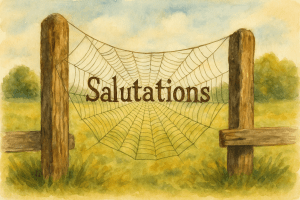
It is quite possible that an animal has spoken civilly to me and that I didn’t catch the remark because I wasn’t paying attention”. – Dr. Dorian in Charlotte’s Web (1952)
Salutations!
In Post #3, I talked about Charlotte’s Web, the wonderful children’s novel by E.B. White that influenced me so profoundly as a child. Reading the book again as an adult has re-illuminated to me the concept of “Equity as a Function of Empathy”, that empathy should be not just lip-service, but active engagement and a commitment to act upon the learned understanding of others situations. If you read the news today, you may wonder where all of our empathy has gone. According to Dr. Helen Riess, Empathy and Relational Science Program, Massachusetts General Hospital in Boston, USA, “While many believe some people are empathic by nature, the capacity to act empathically is mutable and can be depleted in challenging times.”
Indeed, while empathy can feel lacking or completely absent in our systems today, it remains central to the theme that has come to guide my work in AI governance. If we want AI to serve humanity equitably, then those shaping it must learn to centre humans in active and accountable ways that recognise the diverse, often uneven realities people live in. Over the years, I have found myself trying to teach the concept of equity in different contexts to a variety of audiences and most recently, to those tasked with designing and governing the systems that are increasingly running our lives.
To this end, I find myself turning to those who taught me about empathy as a child in hopes that I can take these wholly accessible ethical lessons and translate them into foundational structures and strategies for operationalizing empathy for those dedicated people shaping the systems that will govern our technological future. Especially in consideration of my equity work in public policy, this has brought me back to Charlotte’s Web as one of the clearest and earliest examples of empathy that I remember, even before I was consciously acquainted with the terminology and concept of ’empathy’ itself.
🕸️
When I read Charlotte’s Web for the first time again a few years ago, it spoke to me in a way that it hadn’t before. As I have gotten older, I’ve been making concerted efforts to learn about my childhood literary maîtres à penser. As we all know, this can be a disappointing endeavor, but not in E.B. White’s case. Who was this man who wrote such an influential book? What made him write it? Why does it continue to live rent-free in my brain decades later? I’m not going to be exhaustive here, but I wanted to share a few things I found out about E.B. White and the conception of Charlotte’s Web.
🕸️

“I discovered, quite by accident, that reality and fantasy make good bedfellows.” – E.B. White, in correspondence with Gene Deitch (American illustrator, animator, comics artist, and film director), January 1971
🕸️
- There was a direct inspiration for ‘Wilbur’.
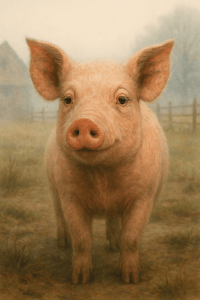
“I spent several days and nights in mid-September with an ailing pig and I feel driven to account for this stretch of time, more particularly since the pig died at last, and I lived, and things might easily have gone the other way round and none left to do the accounting.” – E.B. White, January 1948
Before Charlotte’s Web was written, E.B. White published a quietly devastating and poignant essay called “Death of a Pig”. In it, he tells the story of a pig on his farm in Maine that became ill. He tried everything to save it, but sadly it died. From his account, written only a few months after the event, it is clear that what began as a farming practicality turned into something deeply personal and profound.
“He had evidently become precious to me, not that he represented a distant nourishment in a hungry time, but that he had suffered in a suffering world….I have written this account in penitence and in grief, as a man who failed to raise his pig, and to explain my deviation from the classic course of so many raised pigs.” – E.B. White, 1948
In fact, this had such an effect upon him, in a letter to his editor, he later wrote:
“I do not like to betray a person or a creature, and I tend to agree with Mr. E.M. Forster that in these times the duty of a man, above all else, is to be reliable. It used to be clear to me, slopping a pig, that as far as the pig was concerned I could not be counted on, and this, as I say, troubled me. Anyway, the theme of Charlotte’s Web is that a pig shall be saved, and I have an idea that somewhere deep inside me there was a wish to that effect.” – E.B. White, September 1952
🕸️
2. There was a direct inspiration for ‘Charlotte’.
In a letter of reply to ‘The Pupils of 5B’ Larchmont, New York (December 1952), E.B. White wrote:
“I was delighted to get your letters telling me what you thought about Charlotte’s Web. It must be fine to have a teacher who is a bookworm like Mrs. Bard…I didn’t like spiders at first, but then I began watching one of them, and soon saw what a wonderful creature she was and what a skillful weaver. I named her Charlotte, and now I like spiders along with everything else in nature.”

The same year that “Death of a Pig” was published, E.B. White fortuitously met the inspiration for his titular heroine. In his book, The Story of Charlotte’s Web: E. B. White’s Eccentric Life in Nature and the Birth of an American Classic, Michael Sims recounts the tale. White already had been mulling over saving a pig’s life in a children’s book, but he hadn’t been able to yet concieve how until he met a very particular spider living in his barn at his farm in Maine. One day, after a summer of observing it while going about his usual farm chores and maintenance, he realized she had spun an egg sac. She disappeared shortly afterwards (presumably to expire) and when White had to go to New York for work, he took the egg sac and kept it in his apartment. Several weeks later, the eggs hatched and he watched as the little spiders made their way out into the world. He even let some of them live in the office room for a little while, but relented because the maid felt unable to carry on with her duties.

“As you say, spiders do not talk to pigs, except in the world of the fable. But when conversation does finally take place, in that fabulous and pure world, it is indeed a spider who talks, indeed a pig.” – E.B. White, in correspondence with Gene Deitch, February 1971
🕸️
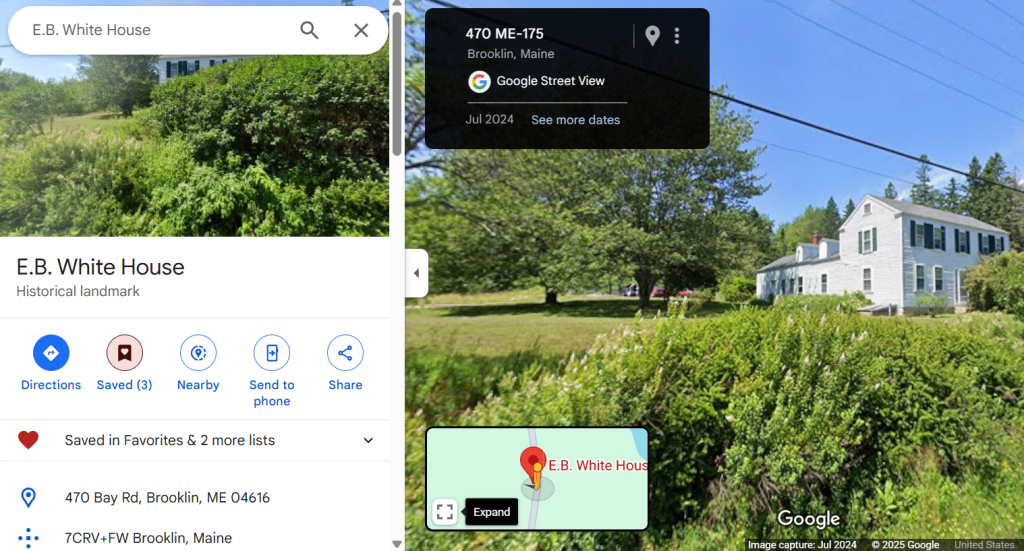
3. You may visit E.B. White’s family’s 18th century farmhouse, The House at Allen Cove, which still stands in Maine today and is on the US National Register of Historic Places. In the meantime, click on the underlined in this section to see where the melding of reality and fantasy for Charlotte’s Web and so much of his writing took flight.
🕸️
Needless to say, I’ve been pleased and immensely relieved to find that one of my most favorite and influential authors of all time was a rather extraordinary human being. I’m going to be returning to E.B. White and Charlotte’s Web in the course of my posts on this blog, of course, interspersed with other relevant discussions. As we continue our conversations around ethics, empathy, and AI governance, perhaps by maintaing a sense of childhood wonder, that kind of open-hearted curiosity and open-minded grace that embraces differences without bias, we can better equip ourselves to govern our emerging realities.
“It is not often that someone comes along who is a true friend and a good writer. Charlotte was both.”
– E.B. White, Charlotte’s Web (1952)
✒️
#AI #AIAndEquity #PublicPolicy #MarginalizedCommunities #PriorityPopulations #Empathy #AIEthics #ArtificialIntelligence #EmergingTechnology #PolicyMaking #OperationalizeEmpathy #CharlottesWeb #Michael Sims #EBWhite #EquitableOutcomes #SocialJusticeAndTechnology #Fairness #AIGovernance #Equity #TheGlobalFAIRSpace #Equity
✳️All graphics on this post were prompted by Natasha J. Stillman and generated by GPT-4o/DALLE-3

 The Global FAIR Space Blog
Leave a reply to N. Stillman Cancel reply